Pixel Art Illustration: An Art Director's Guide to Branding, Editorial, and Advertising
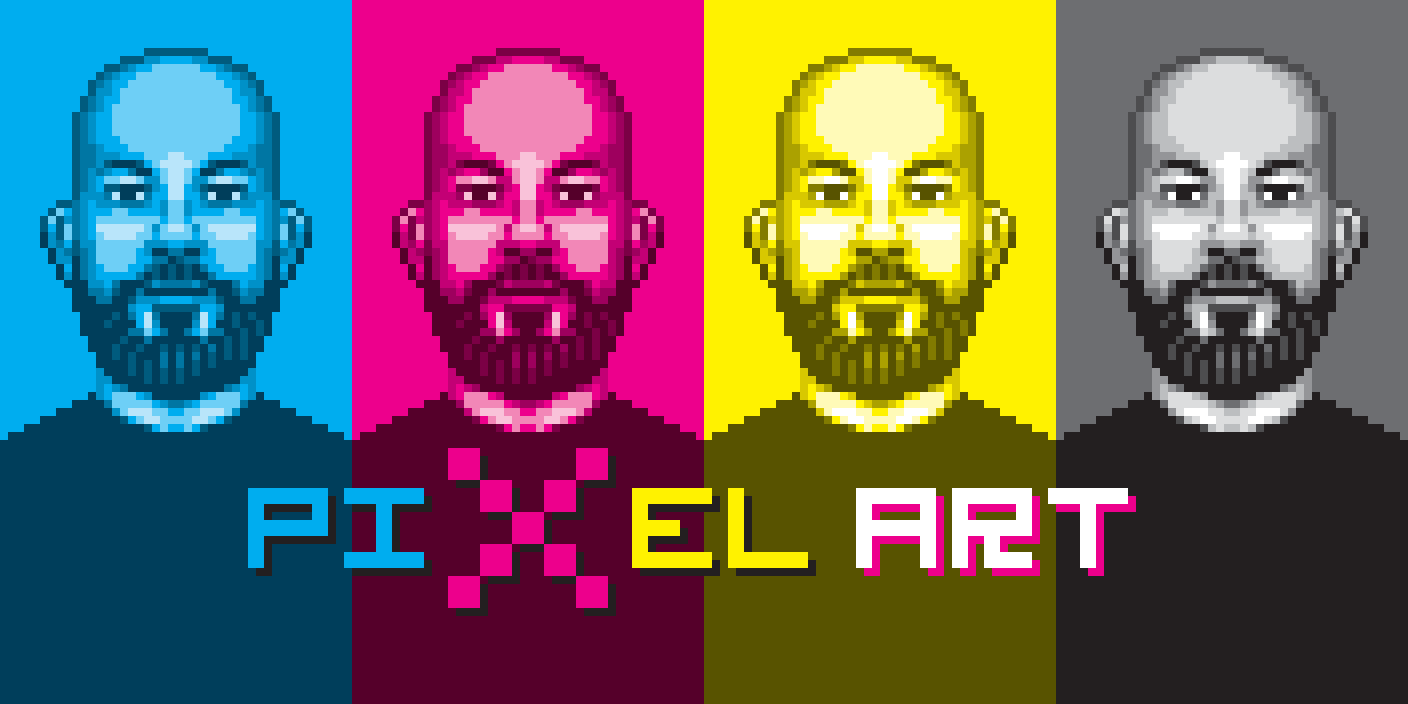
Pixel art is a form of digital illustration constructed from deliberately visible square units of color arranged on a grid. As one of the first illustrators to adapt this aesthetic for print and advertising over 20 years ago, I have helped it evolve from the hardware constraints of early video games into a high-impact commercial illustration choice used across editorial, branding, packaging, and interactive media.
In this guide you'll learn:
What pixel art is and why it remains one of the most versatile illustration styles.
When pixel art is the right choice for branding, editorial, advertising, packaging, and interactive experiences.
Why brands commission pixel art for projects far beyond the video game industry.
How pixel art communicates nostalgia, technology, play, and digital culture.
Although this article will also be useful to illustrators, it is written primarily for art directors, creative directors, editors, marketers, and brand teams deciding whether pixel art is the right illustration style for a commercial project. Rather than explaining how pixel art is made, the examples below focus on when it works, why clients choose it, and what business problems it helps solve.
The contemporary landscape of visual communication often treats pixel art as a niche illustration style, an 8-bit vestige of a bygone era, when computer-processing power was strictly limited to 256 colors or less. However, an honest analysis of the medium reveals that its very obsolescence is precisely what grants it such profound emotional relevance in the modern era. The abstraction inherent in the pixelated grid is what empowers the medium to communicate truth so fearlessly, avoiding the intensity of hyper-realism to access a more primal, symbolic form of recognition. Furthermore, the connection between pixel art and the relatively young medium of video games enables illustrators to access new metaphors in a world increasingly overrun with archaic visual clichés. By leveraging the historical constraints of early computing, contemporary pixel art functions as a sophisticated semiotic system capable of navigating complex narratives in tech, healthcare, lifestyle, and social commentary.
What follows is a strategic breakdown of how pixel art has functioned across a variety of commercial contexts. Together, these five categories represent the overwhelming majority of professional pixel art commissions I have completed over the past two decades. While not exhaustive, they reflect the approaches I've refined across hundreds of commercial projects. The only real limitation of pixel art is the imagination behind it.
In my experience, most commercial pixel art commissions fall into one of five broad categories:
Conceptual Metaphors
Using video game mechanics to visualize complex ideas in editorial and advertising.Nostalgic Anchoring
Leveraging shared cultural memory to strengthen branding, packaging, and period storytelling.Portraits
Positioning individuals within tech, gaming, and digital culture through stylistic alignment.Interactive Experiences
From simulated gameplay for marketing to fully playable branded video games.Video Game Commentary
Framing anniversaries, IP reinterpretations, and cultural shifts within gaming.
Conceptual Metaphors
Best for: Editorial, Institutional, Advertising
Video games have introduced dozens of new visual concepts that didn’t really exist in the public consciousness prior to the medium’s inception. Pixel art can serve as a conduit for translating these conventions into clever metaphors for a variety of applications. There are too many gaming conceits to list, so for this section I will simply be breaking down a few projects and explaining how pixel art enabled each one to access fresh ideas through the visual language of digital gaming.
Life Choices
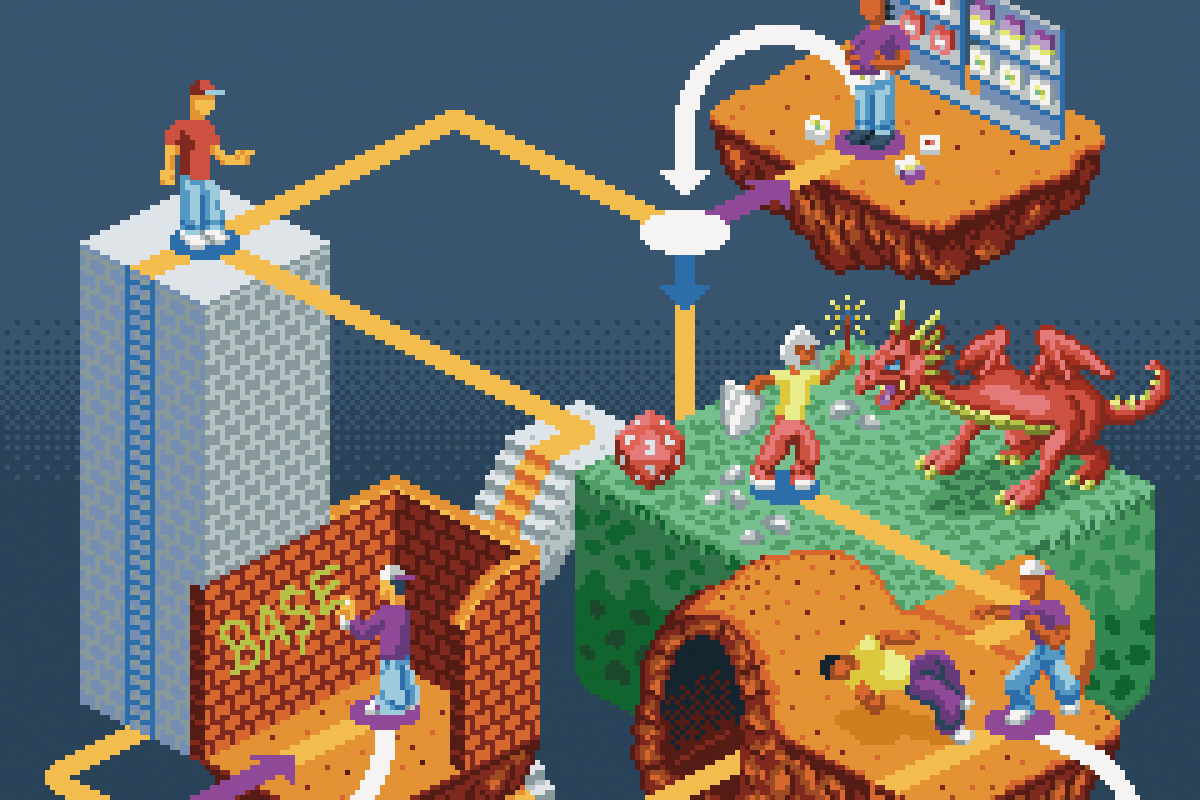
In this public safety campaign for the City of Edmonton, pixel art was used to visualize the concept of adolescence as a branching narrative. The format invites teens to see real-world consequences through the familiar lens of game logic.
An additional benefit of using pixel art is representation; when you use more abstract representations of people, rather than specific photography or realism, more viewers can relate to the situations depicted.
Overcoming Challenges
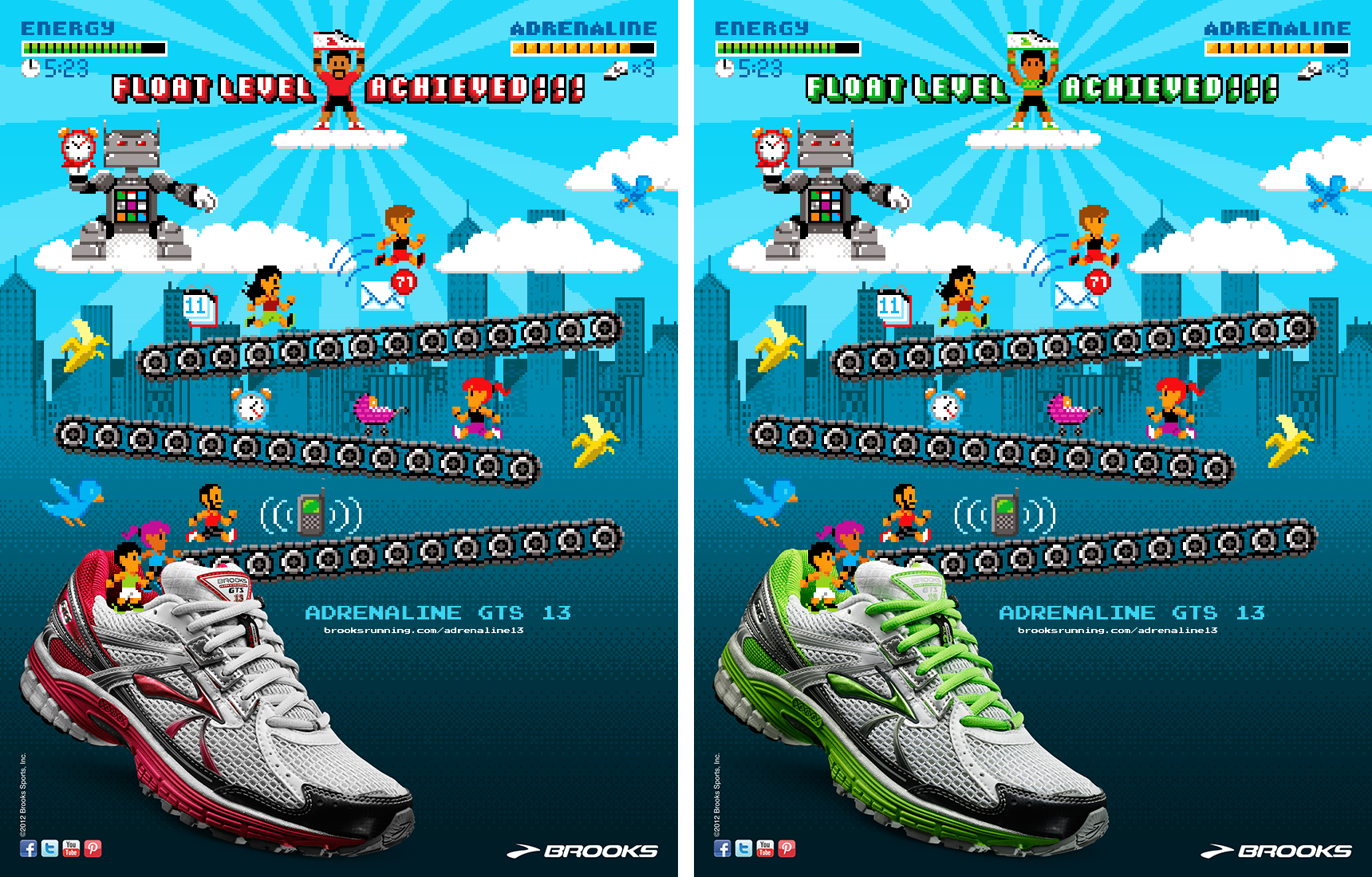
This advertising campaign for Brooks Running uses the structure of a classic vertical platformer to turn daily responsibilities into obstacles standing between the runner and their goals, the final boss being time itself. Power ups come in the form of bananas, with the latest Brooks running shoe being your path to achievement.
Battling Disease
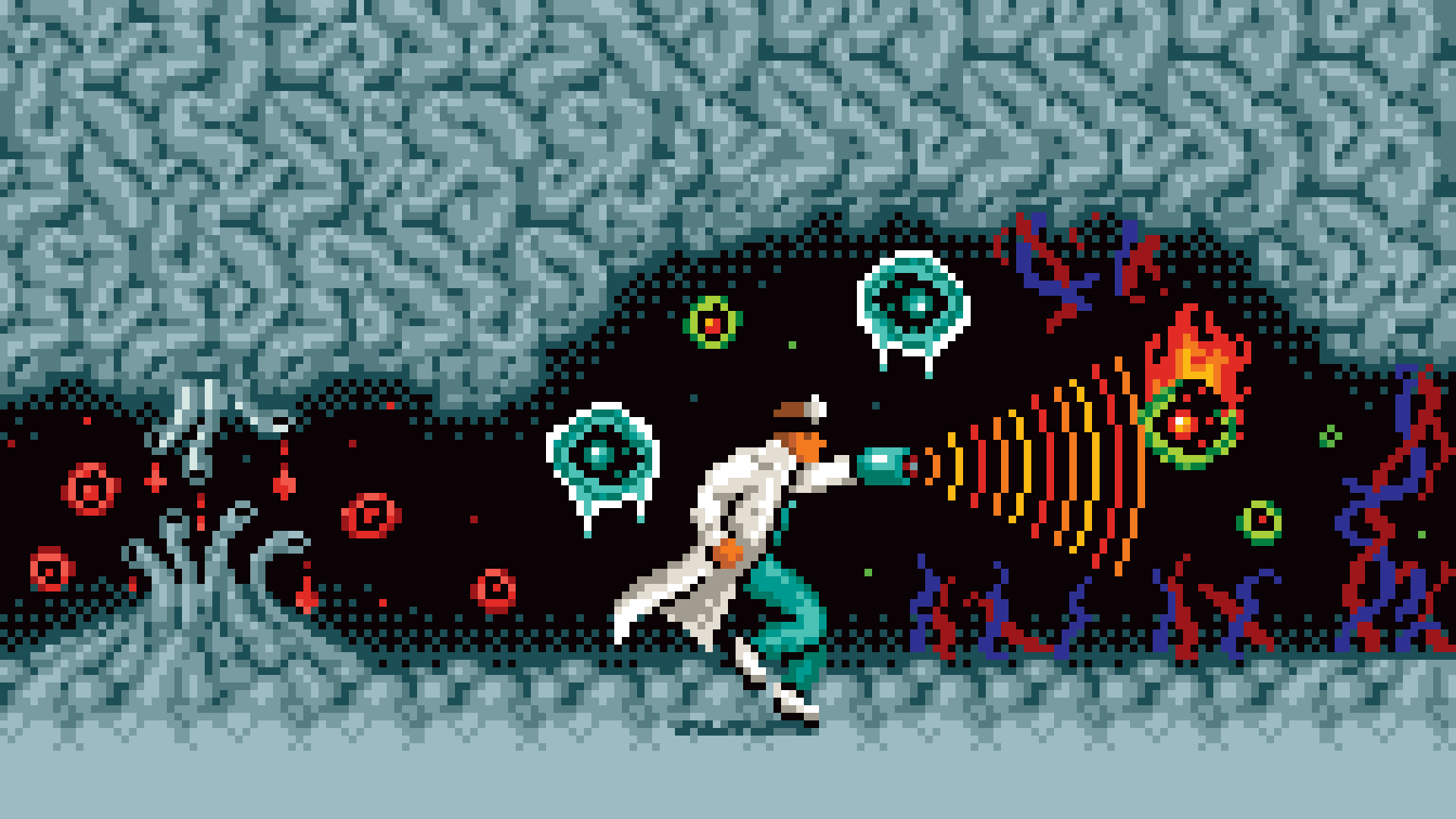
This editorial illustration reimagines interventional radiology as a side-scrolling action game, with a miniature doctor running through the human body. Tumors and blockages are treated like in-game enemies, each requiring a different “weapon” to defeat. The pixel art style makes a complex medical topic feel accessible, playful, and easy to engage with.
Leveling Up
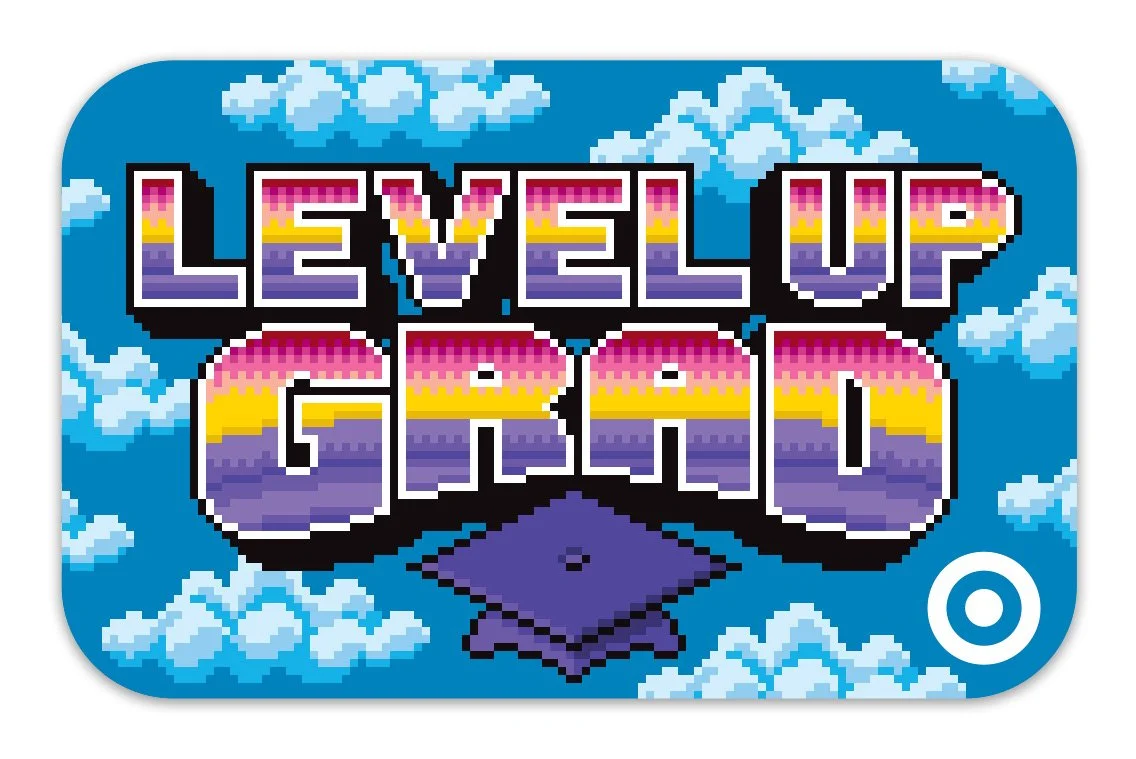
Most video games are built around progression. One of the most common mechanics is earning experience points to advance to the next level. “Level up” has become such a widely understood phrase that it translates easily across industries, as seen in this graduation-themed gift card for Target.
Nostalgic Anchoring
Best for: Branding, Marketing, Packaging, Editorial
For Gen X and Millennials, pixel art is inseparable from childhoods shaped by video games. Even Gen Z formed an early connection to the aesthetic through modern titles like Minecraft and Stardew Valley, part of a broader resurgence of pixel art within the cozy game genre.
That shared familiarity makes pixel art a powerful illustration choice for anchoring projects in 1980s and 1990s nostalgia, and for evoking the games that defined those decades.
Editorial
When an article’s topic is rooted in the 1980s or early 1990s, an accompanying pixel art illustration provides an immediate visual connection to that era by placing the reader inside the cultural period shaped by early video games.

This approach was used for “The Year of Bo”, an ESPN article celebrating the year (1989) Bo Jackson dominated the sports world. Pixel art reinforced the historical framing while also referencing Jackson’s own Nintendo game (1991), aligning the illustration with both the subject and the time period.
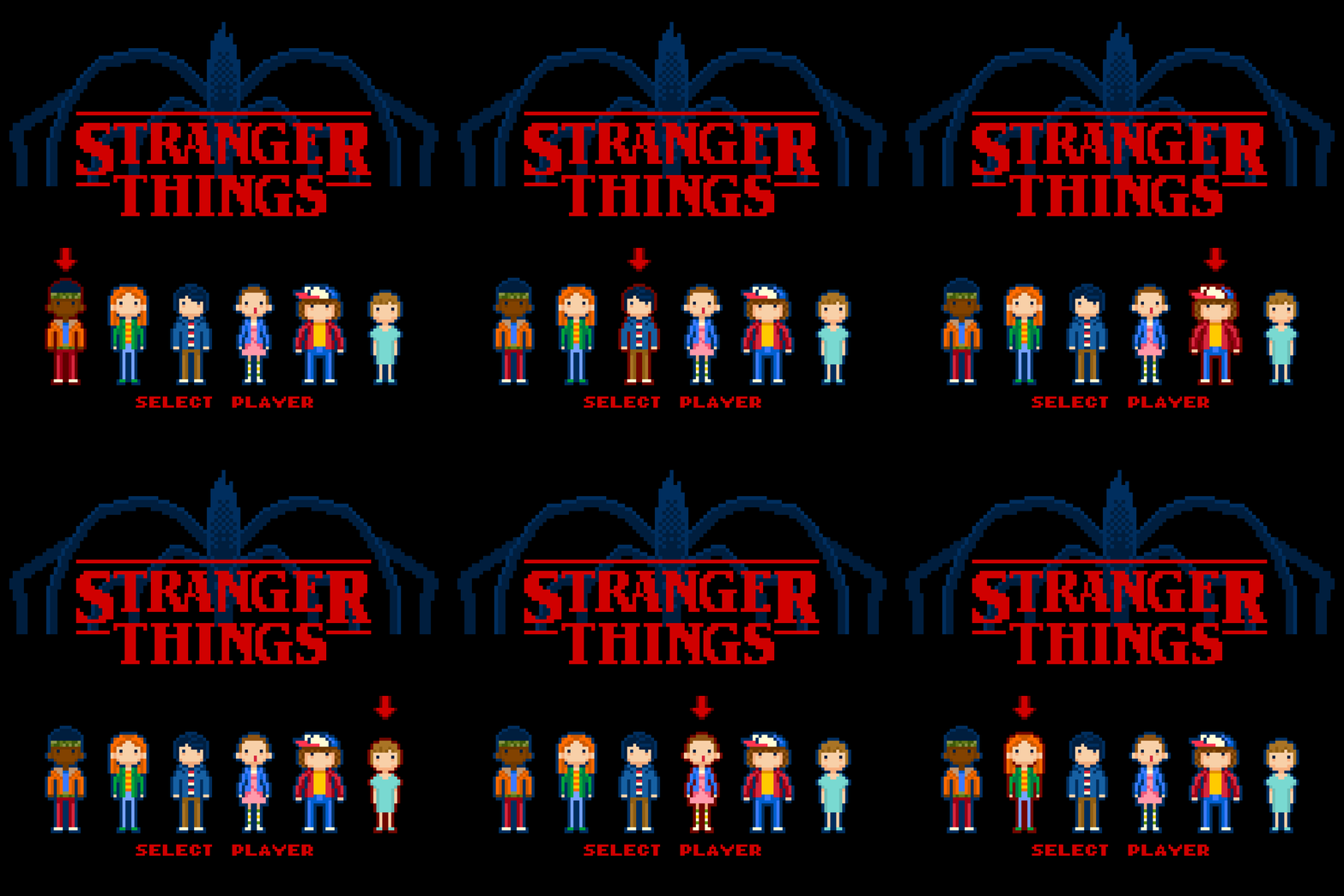
A similar strategy informed a feature on Vulture about Stranger Things. Pixel art RPG-style character portraits and a game-inspired select screen echoed the show’s 1980s setting, using video game language to visually reinforce the world the article explores. The what-if-this-tv-show-was-an-8-bit-video-game idea is a strong concept that has proven adaptable well beyond editorial.
Packaging
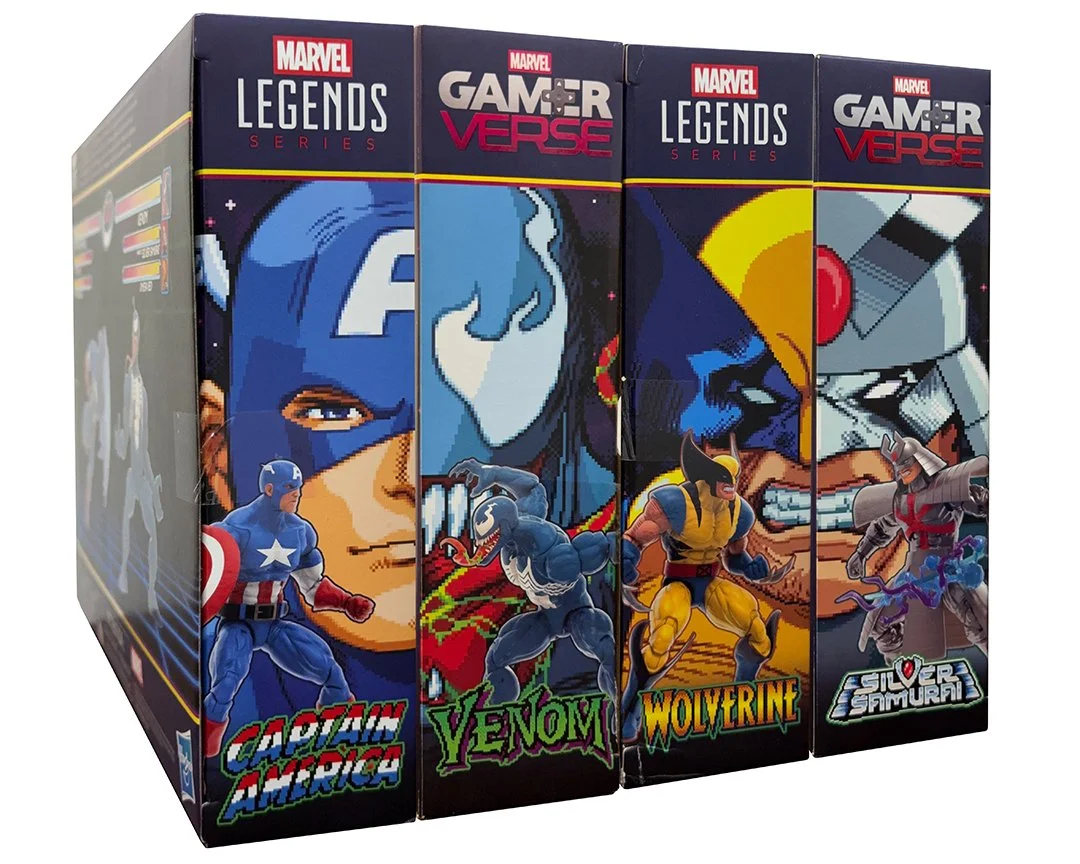
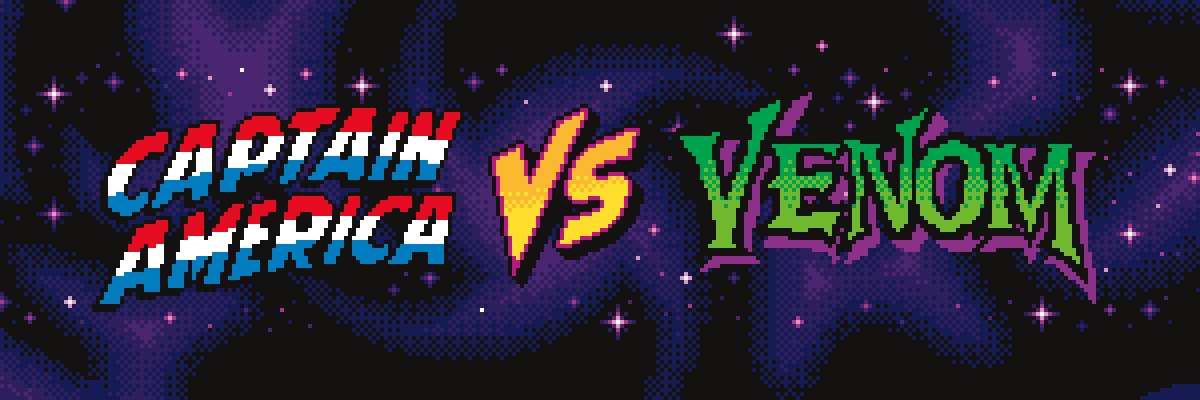
Hasbro’s Marvel Legends Gamerverse line draws directly from the 1990s video game versions of its characters. By using pixel art illustrations on the packaging, along with 8-bit treatments of the characters’ logos, the line clearly signals its connection to gaming while also attracting new fans who might not otherwise engage with traditional action figures.
Branding

Yards Brewing Co. takes a modular approach to branding. Instead of a single unified look across all beers, it operates through distinct sub-brands, each with its own visual language. One of those is the “8-bit” line, which draws directly from the golden age of video games.
This approach allows Yards to stand out in a hyper-crowded industry by tapping into a shared cultural memory that resonates with nearly anyone born after 1970. For industries that have not yet explored pixel art, this kind of targeted sub-branding offers a low-friction way to create instant familiarity while remaining visually distinct on the shelf.
Using pixel art for branding also provides a natural bridge to custom branded video games, extending the visual language into interactive experiences designed to promote a company or product.
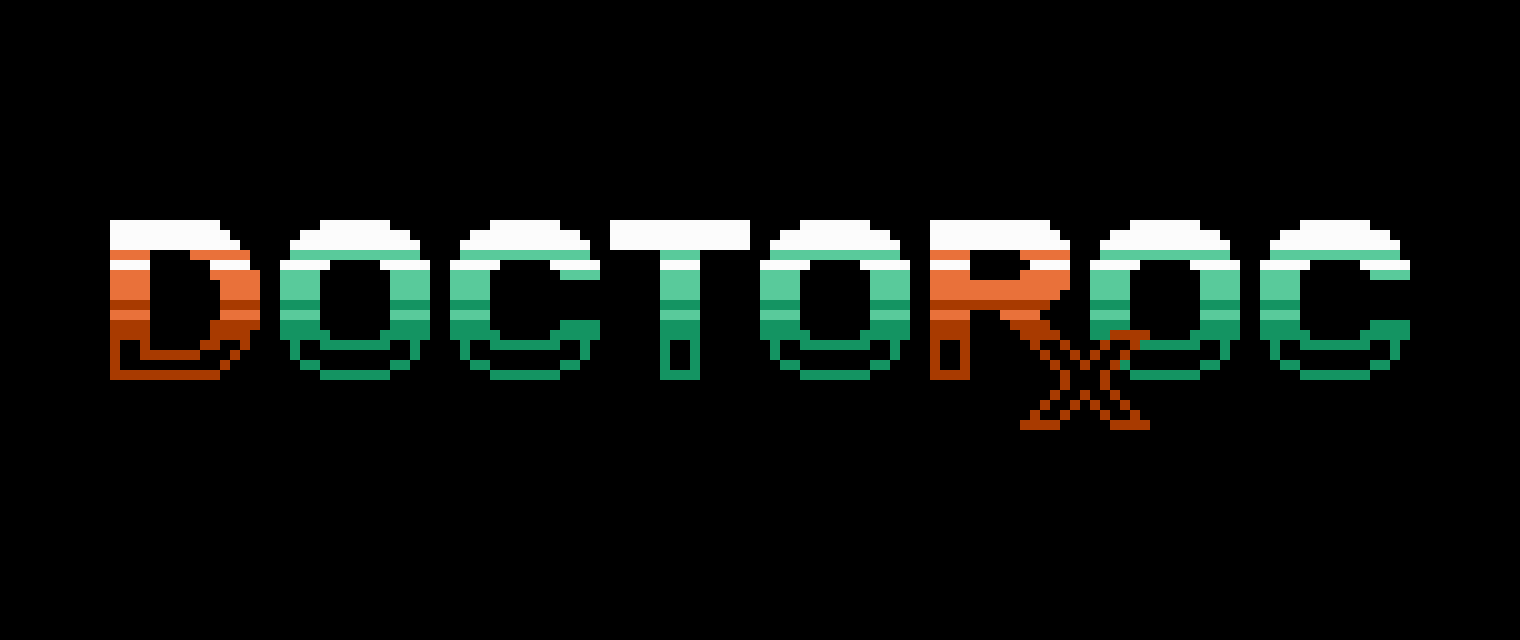
Another practical application of pixel art is for electronic music, especially chiptunes, a genre built on the same technical limitations as early video games. These logos for chiptune musician Doctor Octoroc and the Singing Mountain podcast both leverage pixel art to tap directly into their audience’s nostalgia for video game music.

Portraits
Best for: Editorial (Tech, Gaming, Music, and Alumni magazines)
One of the most common illustration assignments, especially for editorial interviews and articles featuring influential figures, is the portrait. Choosing the right illustration style can be daunting, but there are many professional situations where pixel art is undeniably the most effective choice.
Gaming

The video game industry is the most common context for commissioning portrait illustrations in the 8-bit style, as it creates an immediate visual link to the subject’s professional domain. For instance, when the University of Chicago featured alumnus Alex Seropian, the creator of the Halo video game franchise, they commissioned a glitchy pixel portrait reminiscent of Seropian’s beginnings in game programming. This stylistic choice serves a dual purpose: it honors the history of the medium while providing a contemporary "high-tech" feel that resonates with a digitally native audience.
Computers and Digital Technology

Because pixels are universally associated with computer screens and digital interfaces, pixel art is also a clever choice for portraits of any individual working within the tech sector. Illustrations of figures such as Adrienne O’Keeffe, Josephine Wolff, and Audrey Tang demonstrate how the grid can be used to imply technical fluency and digital architecture. In these cases, the portrait is not merely a likeness; it is a statement about the subject’s environment and influence.


Electronic Music
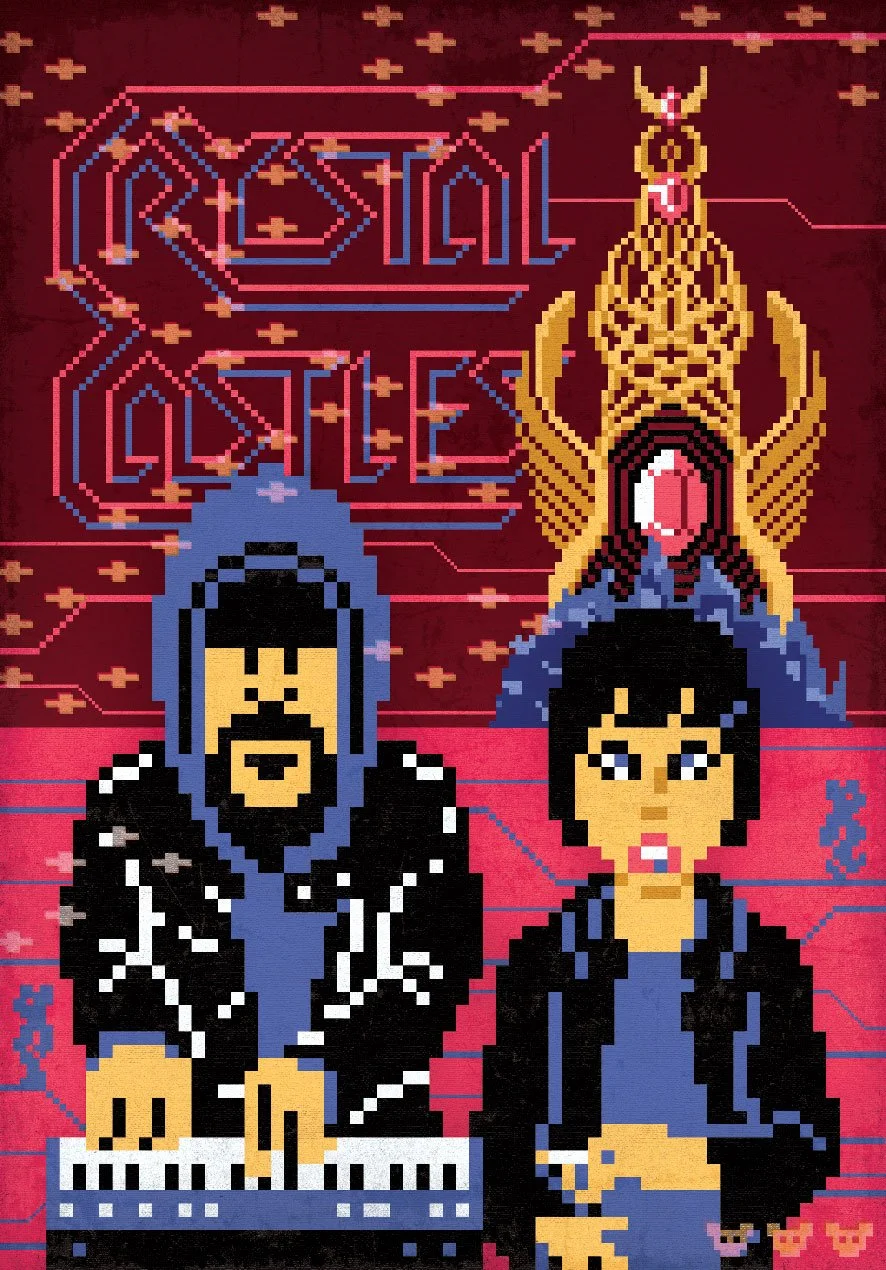
A more unexpected but highly relevant use case for pixel art exists within the electronic music industry. The band Crystal Castles, for example, utilizes retro video game hardware to create their signature sound. Consequently, Mixmag commissioned portraits that incorporate elements from the 1983 arcade game Crystal Castles which inspired the band’s name, creating a multilayered cultural reference that bridges the gap between audio and visual aesthetics.
Interactive Experiences
Best for: Branding, Advertising, IP
It sounds obvious, but pixel art is the perfect illustration style for branded video games and other interactive experiences. As discussed earlier, the aesthetic is extremely popular in consumer games and also allows contemporary brands to be reframed through an unexpected 8-bit lens, instantly signaling play, nostalgia, and approachability.
Simulating Customer Experience
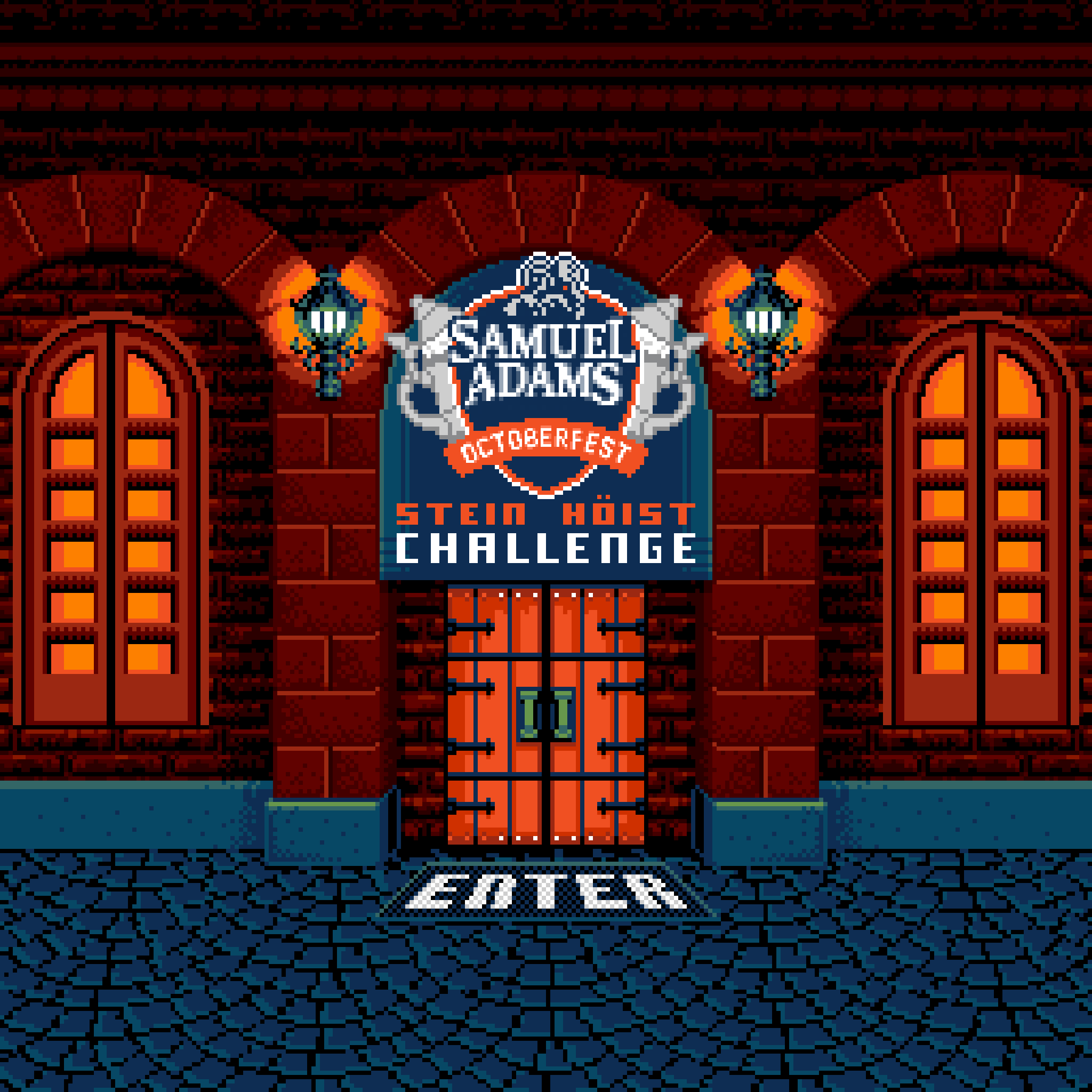
Pixel art can turn ordinary brand interactions into playful experiences. Everyday moments become game-like scenarios that invite participation instead of passive consumption.
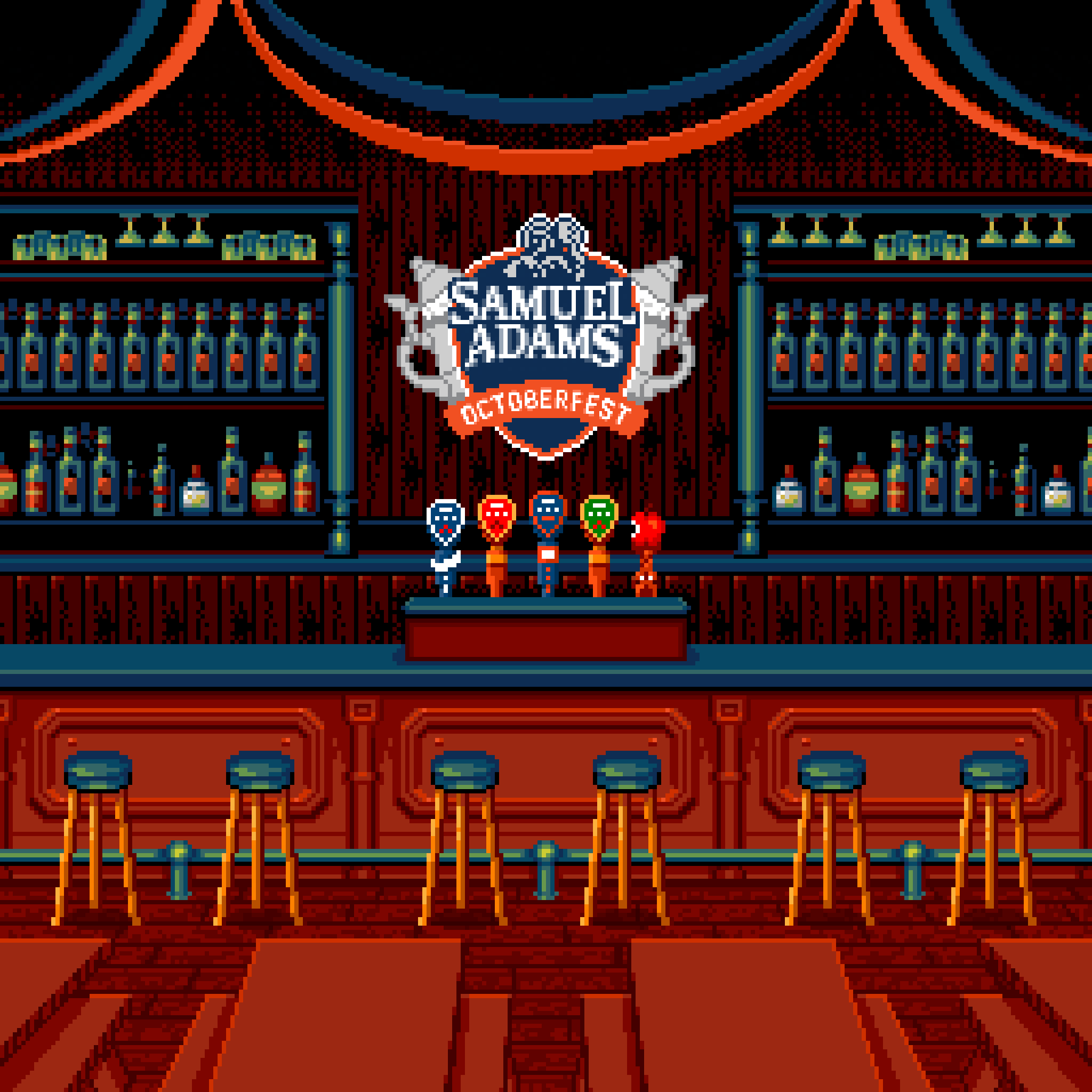
For example, during COVID lockdowns, Sam Adams recreated its Oktoberfest stein-hoisting competition as a virtual experience. With in-person gatherings restricted, pixel art was used to build a digital game space that simulated the communal atmosphere of the event, allowing participants to compete online rather than physically.
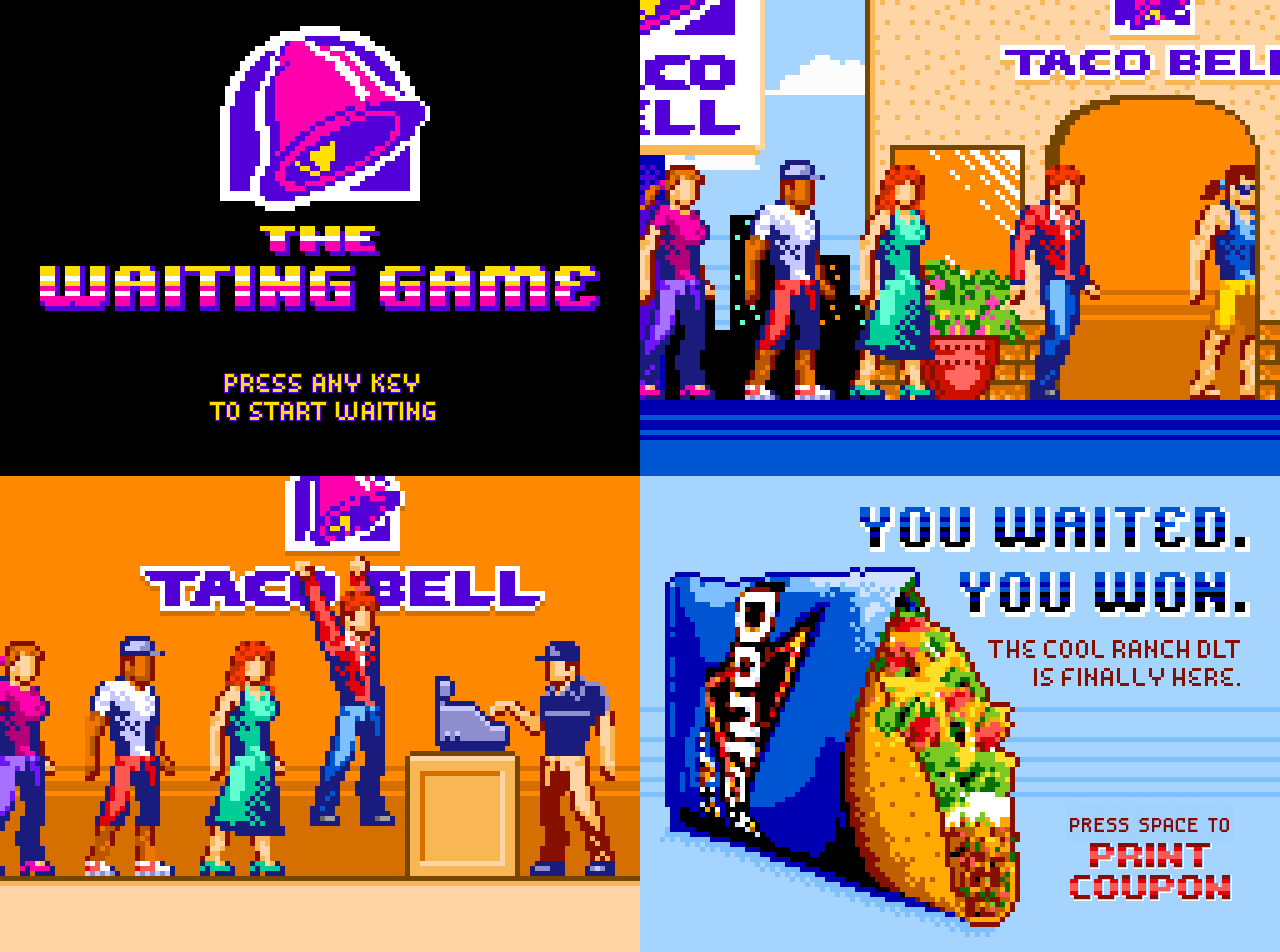
Taco Bell’s “The Waiting Game” in contrast reframed a less enjoyable customer moment. Waiting in line became an arcade-style challenge, aligning the mechanic of the game with the real-world act of standing in line. In both cases, pixel art made the interaction immediately legible as play, turning routine brand touchpoints into interactive experiences.
Simulating Gameplay
Not every interactive project needs to function as a fully built game. Sometimes the goal is simply to borrow the mechanics and visual language of gameplay in order to create the feeling of participation.
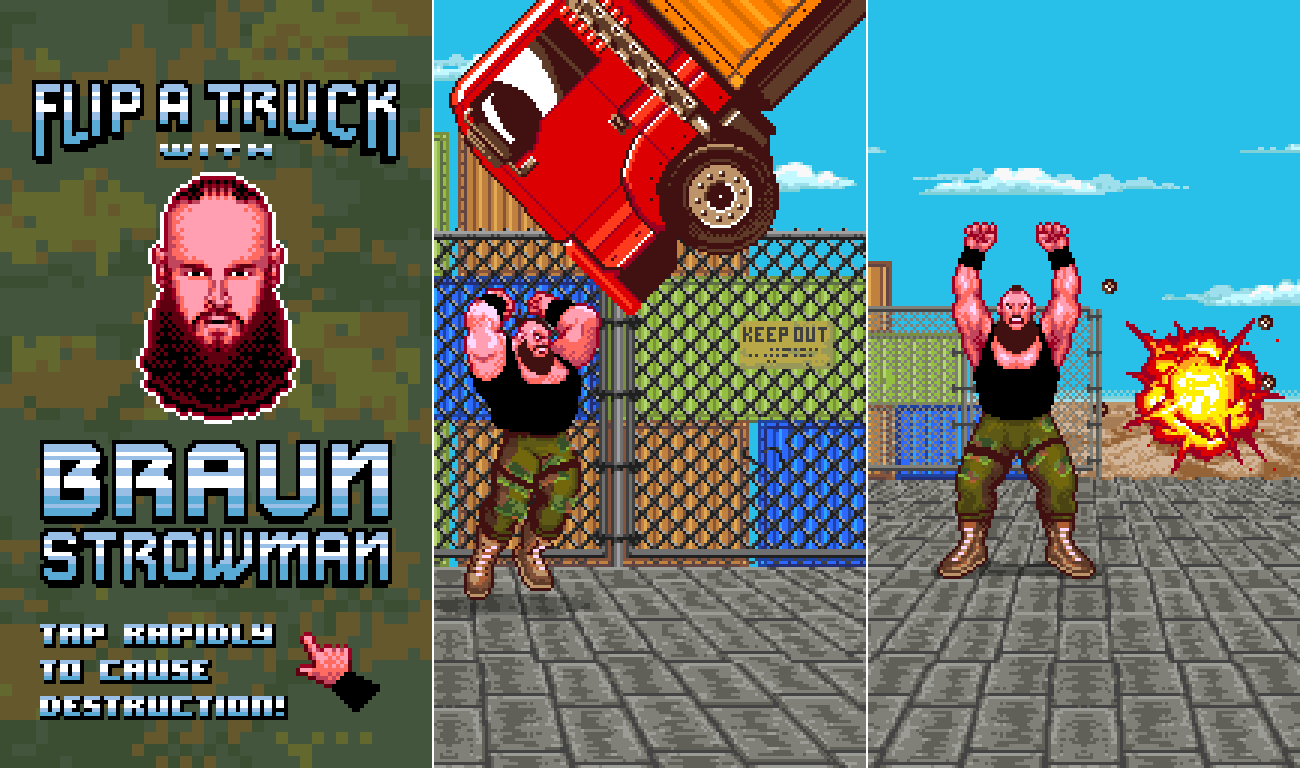
For WWE’s “Flip a Truck with Braun Strowman,” the objective was not to build a full video game, but to simulate the feeling of playing one. The Instagram Story format invited users to tap rapidly, mimicking the button-mashing mechanics common in fighting games.
Pixel art reinforced that illusion. By presenting the action as a series of exaggerated, retro-style frames, the piece borrowed the visual language of arcade combat to amplify the spectacle. The audience was not technically playing a game, but they were still participating in the experience.

Liquidnet’s “Quest for Liquidity” began as a television commercial designed to simulate gameplay. The pixel art was created to mirror a classic side-scrolling adventure, using a hero’s journey structure to visualize the pursuit of “liquidity” as a tangible objective.
Although the project was conceived as an animated narrative rather than a playable product, it was built to look and feel like a real game. The response was strong enough that the concept was later developed into an actual iOS and Android game, extending the simulated experience into a fully interactive one. Which brings us to…
Branded Video Games
When a project moves beyond simulation and becomes a fully playable branded video game, pixel art is often the most efficient and conceptually coherent choice. The style carries decades of established game grammar, making mechanics, objectives, and feedback loops immediately understandable. For brands and IP holders, this allows interactive experiences to feel legitimate without requiring the scale of a major studio production.

Adult Swim’s Hot Streets browser game represents a middle ground between full-scale commercial games and simple interactive promotions. Rather than monetizing an established franchise, the goal was to introduce and promote a newer property through a playable experience. Pixel art made it possible to quickly translate characters and world-building into a recognizable game format. By leaning into classic arcade structure, the project allowed audiences to engage with the IP as players, not just viewers, without requiring the budget of a major console release.

Coach’s holiday campaign took a more straightforward approach: build a branded video game that reinforces the identity of the company. The side-scrolling snowboarding format placed the brand’s mascot at the center of the action, while products appeared as collectible objects within the game world. Here, pixel art functions as a seasonal shift in tone. The 8-bit filter makes a luxury brand feel playful and accessible without undermining its core identity, offering a festive interactive layer that extends beyond static advertising.
Video Game Commentary
Best for: Editorial, Publishing
When the subject matter is gaming culture, history, or criticism, pixel art provides an immediate visual shorthand that signals fluency in the medium. Because the style is historically tied to early console and arcade systems, it can be used to frame anniversaries, retrospectives, and commentary on the evolution of gaming. At the same time, its continued relevance in modern indie titles allows it to bridge past and present without feeling purely nostalgic.
Reframing Established IP
Pixel art can be used to reinterpret well-known properties by translating them into a different visual framework. Shifting the medium, or even just the resolution, changes the emphasis, allowing familiar mechanics and themes to be seen from a new angle.
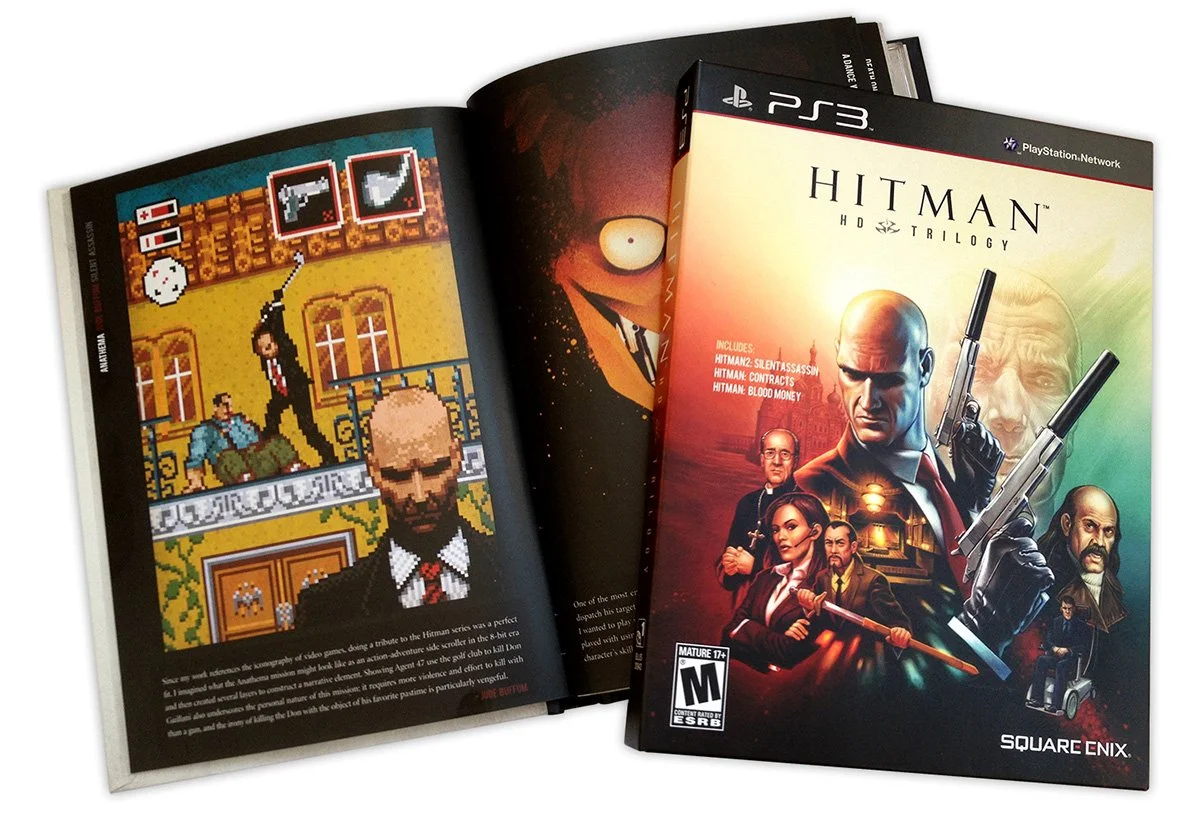
To add collectible value to the Hitman Trilogy Premium Edition, Square Enix included an art book featuring over 20 artist reinterpretations of the franchise IP. This pixel art illustration reimagines the modern stealth video game as a classic 8-bit side-scroller.
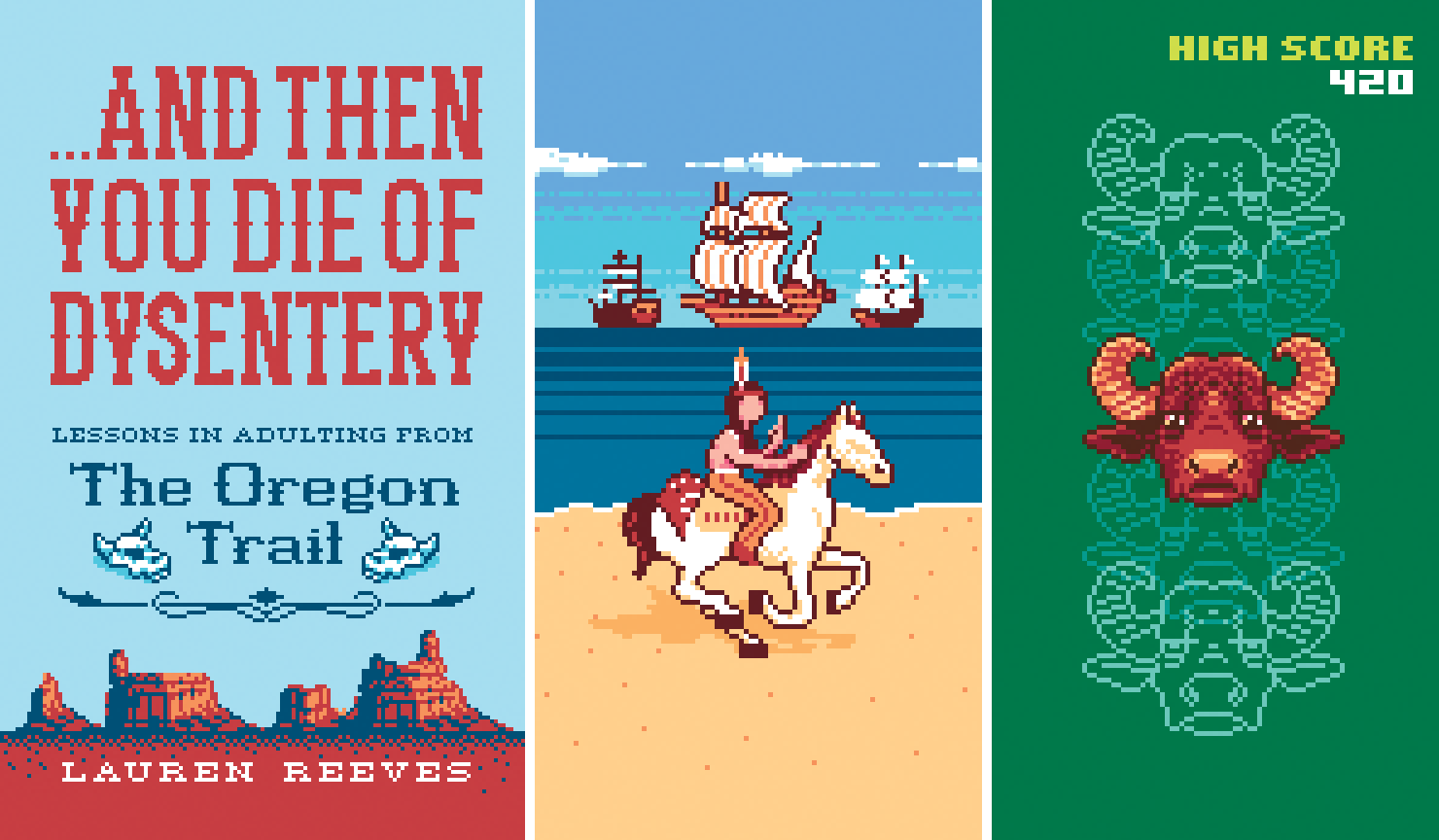
Lauren Reeves’ book And Then You Die of Dysentery… draws directly from the deep lore of The Oregon Trail computer game. Rather than strictly duplicating the hardware limitations of the original game, the pixel art expands on its visual language while preserving its recognizable tone. The result reframes adult life lessons through the logic of early educational software, treating modern anxieties as in-game failure states.
The same approach works just as well on properties that were never games to begin with. In this series, beloved films and TV shows are reimagined as 8-bit games that never existed, each condensed into a single fake screengrab.
Video Game History
When subject matter centers on a specific era, console or game, pixel art functions as a historically accurate visual language rather than a mere decorative choice.

This pixel art animation accompanied a Polygon retrospective on the 30th anniversary of the Nintendo Game Boy. The hero image, a victorious flying Game Boy, was illustrated in full color while the background was limited to the handheld’s iconic 4-color pea-green palette. Falling Tetris pieces referenced the best-selling game that came packaged with the original unit.
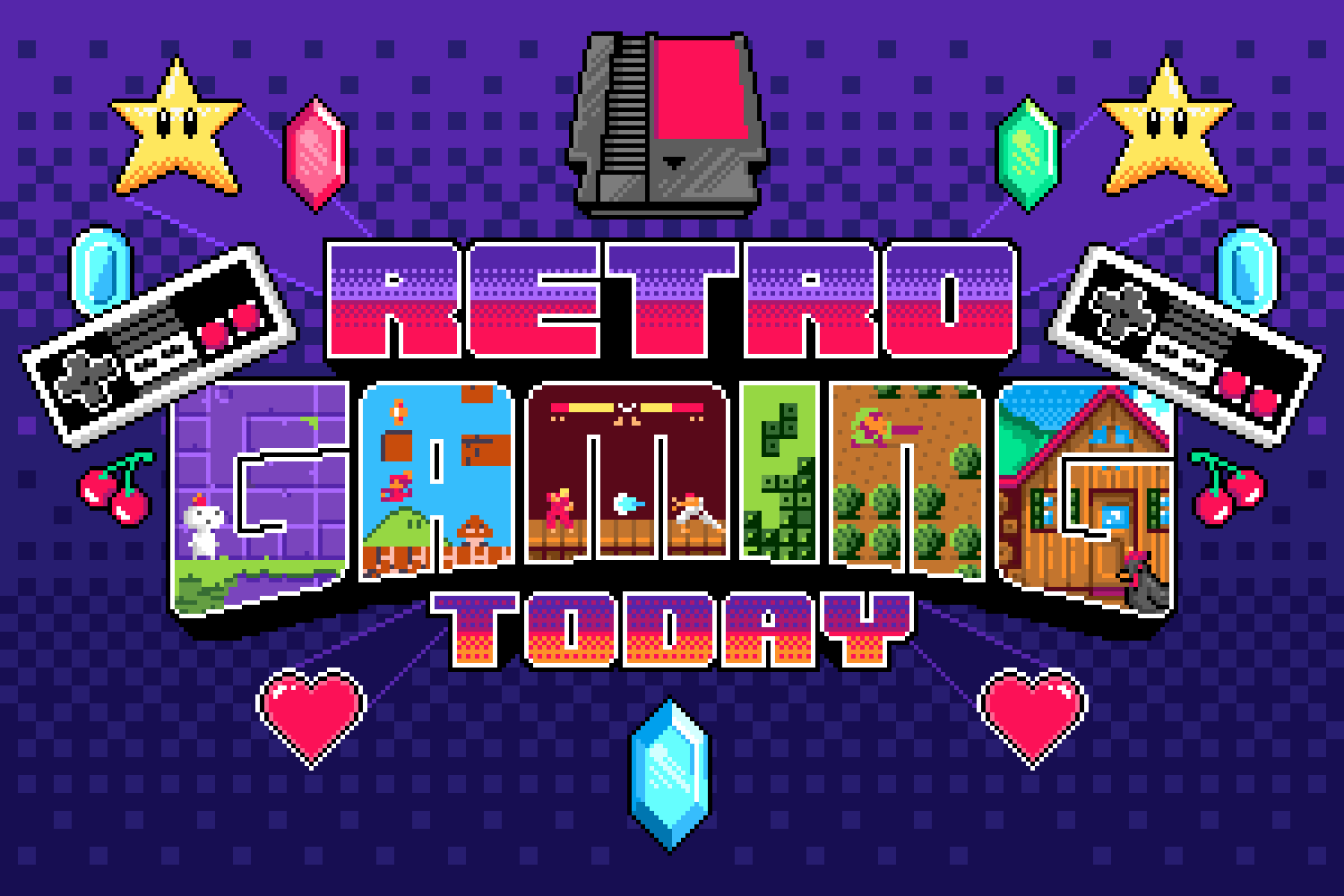
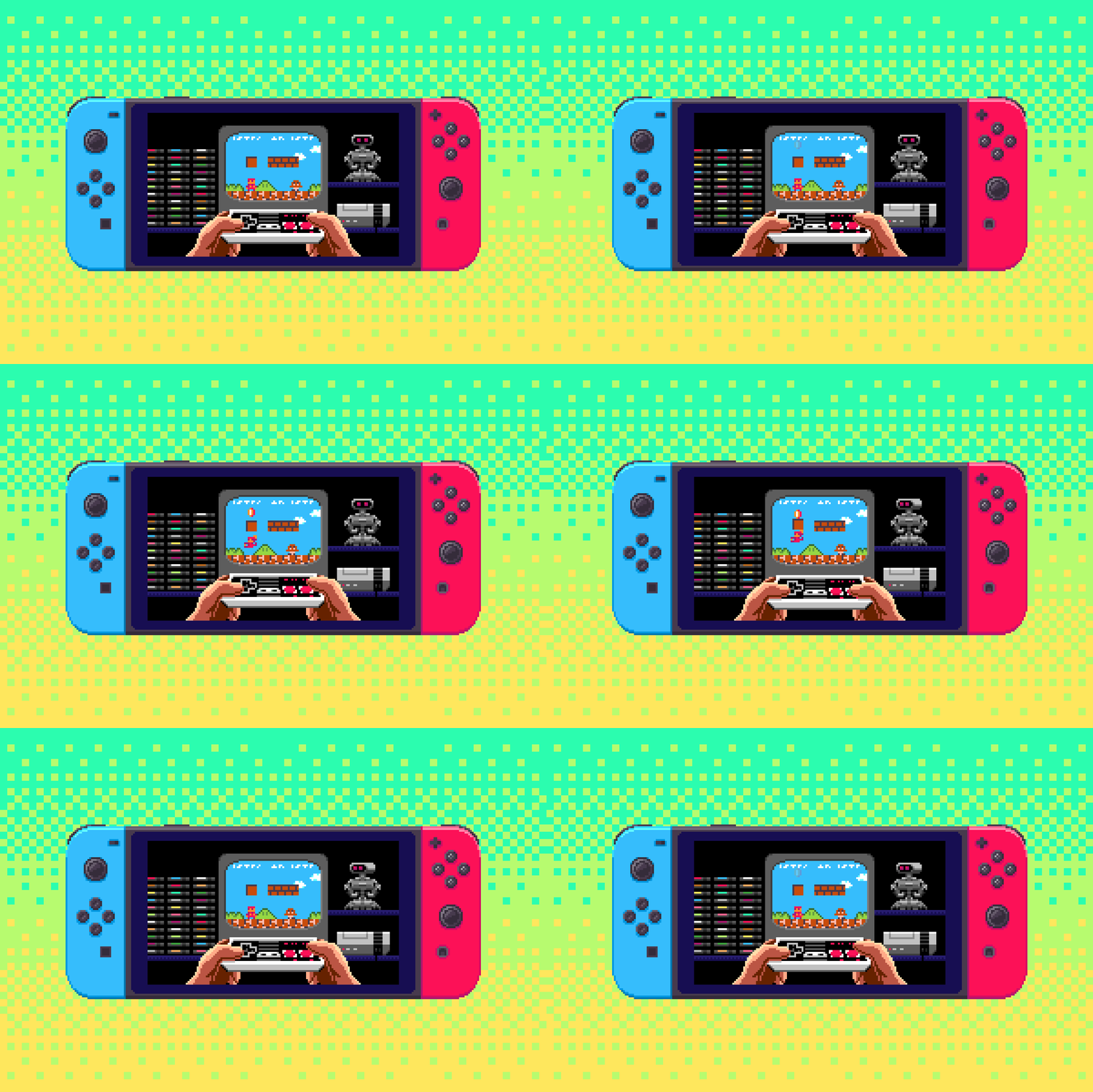
For another Polygon package titled “Retro Gaming Today”, an article examining the current state of classic gaming on modern hardware, 8-bit typography and modular pixel art assets framed retro gaming as an active ecosystem rather than a museum piece. An additional pixel art animation focused on the section about playing classic NES games on the Nintendo Switch console.
Gamer Culture
Pixel art is also effective when the subject is not necessarily the games themselves, but the people whose lives and identities are shaped by them. By adopting the visual language of familiar mechanics and interfaces, the same art used to build games can reflect back the meaning we find in them.

This pixel art portrait, a queer homage to American Gothic, accompanied a Stanford Magazine story about an alumnus on the autism spectrum who established a married life within the farming simulator Stardew Valley. Using the title’s visual style, the illustration features his avatar and in-game spouse, aligning the aesthetic directly with the world in which he experiences partnership.

For an editorial feature about millennial newlyweds who turned to gaming during the pandemic as both escape and bonding ritual, The Washington Post commissioned a series of pixel art animations that framed the couple’s relationship within familiar gameplay structures. Game mechanics such as cooperation, exploration, and problem solving became visual metaphors for partnership by casting the relationship as a shared quest rather than a simple pastime.

This same approach was used for another Washington Post feature that used pixel art to explore the question of who gets to be considered a gamer. By treating seniors, women, and families as default protagonists within familiar genre frameworks, the illustrations invert the stereotype without preaching. Game conventions such as character selection screens, level progression, and boss battles function as editorial devices, reinforcing the article’s central claim that gamer demographics have shifted and that contemporary gaming culture is far more expansive than outdated assumptions suggest.
Why Pixel Art Still Matters
Pixel art is a visual system shaped by decades of interactive media, one that carries built-in associations with identity, progress, challenge, and play. It’s often mistaken for a mere retro aesthetic but, for art directors, it is uniquely versatile.
It can craft unique metaphors, power branding systems, design interactive frameworks, illuminate historical reference, or provide cultural commentary. Its abstraction invites personal identification, its constraints focus meaning, and its connection to video games provides an instantly recognizable structure for storytelling.
In an era plagued by oversaturation of high-fidelity (and often AI-generated) images, the modest pixel art grid stands out, not because it imitates the past, but because it activates a language most audiences already understand.
Looking to leverage pixel art for your next project? I’ve been helping Art Directors translate complex concepts into 8-bit visual language for over 20 years. Let’s talk pixels!