
When Pixel Art Leaves the Screen: From Digital Art to Physical Creation
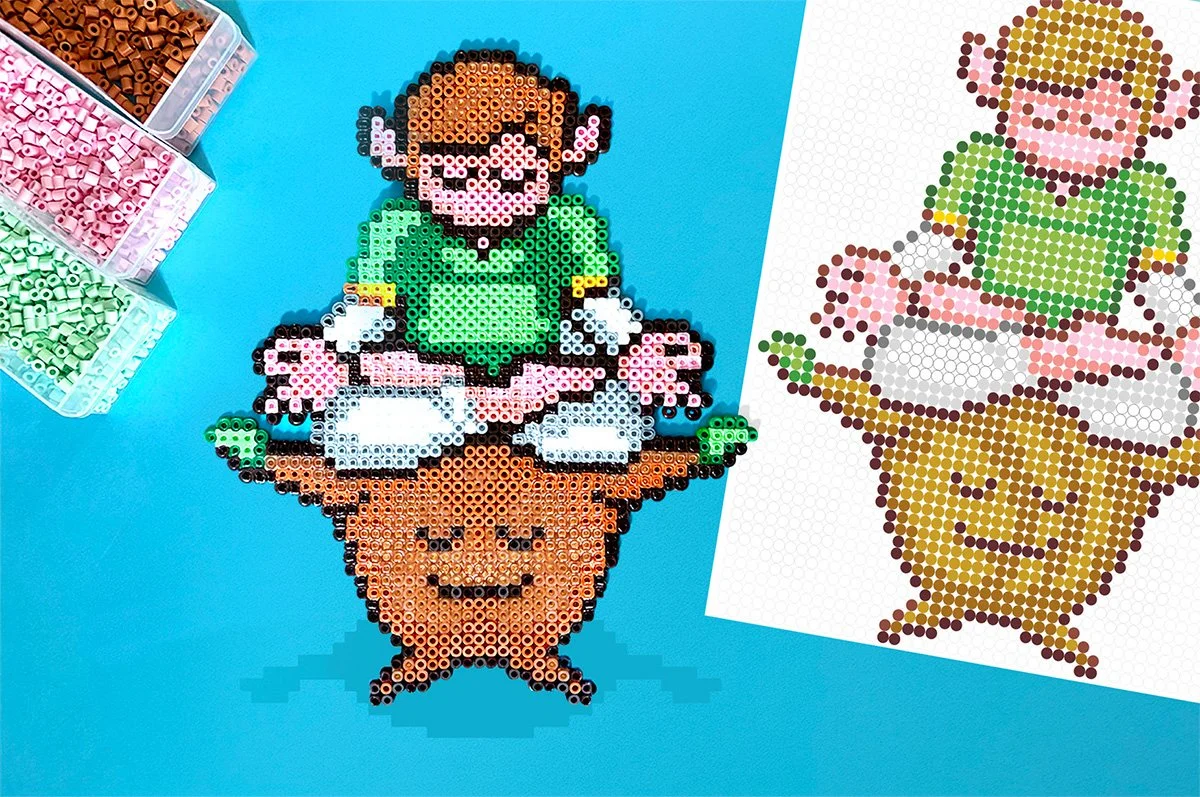
This is a guest post from Mylène S. the creator of Mes Perles à Repasser, a French site full of free printable perler bead patterns. They recently adapted a piece from my "Pause" series into a bead creation, and were kind enough to write this lovely reflection on pixel art making its way from the screen into the physical world.
Pixel art is a unique visual language.
With only a limited color palette and a restricted grid, artists are able to create characters, emotions, and entire worlds.
Every pixel has a purpose. Every color tells a story. This is what makes pixel art so fascinating: behind its apparent simplicity lies a true mastery of composition.
An art of precision and intention
Creating pixel art is not about drawing freely. It means working within strong constraints: a limited space, a restricted palette, and no room for approximation.
Every pixel placed is a choice. Nothing can be unnecessary.
This discipline requires real technical skill: anticipating the readability of a silhouette, balancing contrasts, and expressing emotion through only a few dozen points of color.
This expertise, often invisible to those discovering the final image, is something pixel artists develop over years of practice.
A popular art form seeking recognition
Pixel art has been part of our cultural landscape for more than forty years.
It grew alongside video games, became part of avatars, emojis, interfaces, and popular culture as a whole. Few visual languages have crossed generations so successfully, from arcade players of the 1980s to teenagers scrolling on their phones today.
Its recognition as an art form in its own right is still developing. Some institutions have started to acknowledge its cultural importance: the Museum of Modern Art in New York includes Pac-Man and Tetris in its collection, while the Victoria and Albert Museum in London explores video game creation as a cultural field.
However, these examples remain limited. For many people, pixel art is still primarily associated with gaming, nostalgia, or entertainment, rather than considered a form of artistic expression.
Yet for decades, pixel art creations have increasingly moved beyond screens and into our physical spaces: becoming objects with a tangible presence and extending this extraordinary source of inspiration into the real world.
Giving form to what existed only as light
On a screen, a pixel is a small unit of light.
Through perler beads, embroidery, or mosaic tiles, it can become a physical object.
This transformation is not only about changing the medium. It connects directly with the essence of pixel art itself.
Invader, who made his pixel-inspired mosaics famous around the world, has shown for decades that moving from the screen to the physical world does not diminish an artwork. Instead, it reveals its inner structure by making it tangible.
It becomes another creation in its own right.
From pixel art to creative crafts
Today, more and more people are rediscovering handmade creative practices: embroidery, cross stitch, mosaic, and other crafts where images are built one element at a time.
This growing interest is not accidental. These creative processes respond to a need to slow down and reconnect with a more mindful way of creating in a world filled with constant stimulation.
Psychologists describe this state as "flow": a moment when the mind becomes fully focused on an activity, leaving distractions behind.
A repetitive and hands-on creative process can help us slow down, reduce stress, and reconnect with the present moment.
The "Pause" series: when heroes take time to breathe
Some artists explore this idea of pause directly through their work.
This is the case with the "Pause" series, where well-known video game characters are portrayed in moments of calm and reflection.
It is a reminder that even within the most action-packed worlds, there is room to stop, breathe, and simply exist.
Creating is also a way of reclaiming time.
In a world where everything moves faster and every interaction is expected to be immediate, spending an hour building an image pixel by pixel, or an object piece by piece, becomes almost an act of resistance: a way to embrace a slower and more conscious rhythm.
Perler beads: an introduction to pixel art
For longtime fans, pop culture enthusiasts, and millennials, pixel art remains a fundamental part of visual culture.
Today, some of its principles naturally appear in children's creative activities: coloring by numbers or pixel-based coloring sheets are loved by many children, even when they do not know that they are engaging with the foundations of pixel art.
Among the creative activities that bring this language into the physical world, perler beads have a unique place.
Accessible from an early age, they require no screen or software, only a pegboard, colors, and patience.
For children, recreating a pixel character with beads becomes a first hands-on introduction to composition, color choices, and grid-based thinking: the same foundations used by pixel artists.
These practices give pixel art a second life, from the first creations made by young hands to the satisfaction of completing a finished physical piece.
Two mediums, one language
Pixel art and perler bead creations ultimately belong to the same universe.
One uses the light of a screen. The other uses physical materials.
But both require the same discipline: building with a grid, choosing each color carefully, understanding symmetry, and developing focus and patience.
Pixel art does not exist only in digital environments.
It can take many forms: animated, printed, embroidered, built.
Each medium reveals a new side of this visual language and reminds us that mastering pixel art is a true skill, while bringing it to life through different forms is a creative pleasure.